Pin It

Sunday, July 15, 2012

Our Visit to the Seed Savers Heritage Farm

What a wonderful weekend we had in Decorah, Iowa!  Our good friend, Gretchen, grew up there, and we've enjoyed her enthusiasm and love for her hometown in dozens of conversations throughout the years. Since Andy and I began gardening in 2007, we have purchased our seeds from a non-profit organization called Seed Savers Exchange,which is also located in Decorah. Each January, the new seed catalog arrives and invites viewers to buy seeds (of course) and come visit Heritage Farm. Biannually in July, Greg Brown visits for a Benefit Concert for the farm. The event's advertisement pictures always look ideal, and wow- ideal it is!

Decorah itself is a little bubble of bliss, and we shopped around on its downtown streets, ate a delicious meal at Rubaiyat, devoured breakfast burritos and iced coffees at Magpies, visited the Wildberry Winery and frequented the Oneota Co-op several times. For the purpose of this post though, Seed Savers gets all the attention. My expectations for experiences seem to always exceed reality -- but not in this case. I fell in love upon pulling into the driveway. Like kids in the middle of Willy Wonka's Chocolate Factory, Andy and I rushed around Seed Savers Heritage Farm with no direction, gawking at flowers and vegetables and trellises and farm animals. It took us a good solid hour before we could explore anything with any sort of organization or direction.

In the front lawn, a variety of  flowers and vegetables reside. If you're a gardener, it's difficult to pry yourself away. Any idealism I had lost with Madison's lack of rain was rejuvenated by the bursting colors and buzzing bees in which I delighted during this visit. I made several trips into the Lillian Goldman Visitors Center to purchase flower seeds for next year. I also got a bit camera happy.

Love-in-a-Mist "Oxford Blue" (bought some seeds!)

Love Lies Bleeding

Spider Flower

A bed of delectables

In the back, you can visit Diane's garden. Diane Ott Whealy is a co-founder of SSE, and she designed a magical garden of flowers and vegetables.


Amaranth, corn, and flowers...hoping to do something similar in our yard
Behind that is the children's garden with willow huts and fences.


And the Heritage Farm even has rare breeds of farm animals. The Ancient White Park Cattle are a sight to behold. Through conversations with some of the Seed Savers staff and from information on the website, I learned that these white cattle traversed on the English Isles since before Christ was born. Now, there are only 800 left, and about 80 of those reside at Seed Saver's Heritage Farm.


Other farm animal sightings included heritage breed ducks, geese, chickens, and turkey. We're told that in the Historic Orchard, there are also pigs, but we didn't have the chance to check the orchard out.

The best thing about Seed Savers Exchange is that the 37-year-old organization's mission is to protect and share the diversity of heirloom seeds and plants.With Seed Saver's leadership, gardeners around the world are able to partake in nature's wide variety of food and flowers and make sure that such variety is here to stay. With large corporations controlling much of what we eat and grow, Seed Savers Exchange and organizations like it are essential to protecting all that the world has to offer.

Greg Brown, accompanied by Bo Ramsey, took time in between songs to discuss the importance of local food and seed diversity. For foodies/gardeners such as us, the setting couldn't have been more ideal: folk music (some of it about food), sunsets and hills, colorful gardens, kind/like-minded people...it was truly wonderful.


And my garden dreams are restored! Look for future posts regarding obtaining ducks (I think I have Andy convinced!), weaving willow fences and shade structures for the chickens, growing flowers and more flowers, saving seeds, and doing more edible landscaping.


Sunday, July 8, 2012

Summer Heat, part one: R.I.P. Prudence

Prudence, during last year's heat wave
Wisconsin is known for its blizzardy winters, and those that have lived here before also know that the summers can be quite hot and humid. Having lived in both Central and Southern Wisconsin, I've come to further appreciate the stark difference - our summers are often a tad warmer than those where I grew up. This last week though, Southern Wisconsin (and maybe the whole state!?) faced unprecedented heat. We were under a heat warning for six days, with temperatures over 100 for five of them. The humidity didn't help. We knew our pets, specifically our chickens would need a lot of care. We looked up last year's blog past regarding heat and did what we needed to do: water baths, lots of water, free-ranging and leading the hens to the shade, and frozen treats. It didn't matter. On Wednesday, Prudence went into her coop to lay an egg, emerged a few hours later, and fell over -- dead.

If you've followed our blog for any length of time, you'll know that we see our chickens how many people see their pet birds, cats, or dogs. We truly love them, and it was shocking to witness one of our ladies literally drop dead from the heat. We buried her, and then went into emergency mode with the other hens. We brought Sadie into the house where it was a little cooler and put her in the bathtub with some frozen berries.

She perked up after about 10 minutes in the water. (Don't mind our rusty tub!)
We filled up a kiddie pool and took turns setting each of the hens in the water (Rocky, the rooster, was not appreciative of this experience). Janis didn't mind it at all...

My little hen princess eventually laid down in the water.
And, for the rest of the week, we took hens that were laying eggs out of the coop occasionally to put their feet in cool water.

Then, we asked the questions: Were we negligent in some way? Did we do something wrong? Could we have done more? And, painfully, we decided that yes - there were a few things we could have done better.

For starters, when we got our coop two summers ago, we put it next to the house, which is right in the sun.

 We did this because we wanted to be in close proximity to the coop to listen for predators and to interact with our flock frequently. We also did this because we thought our winters would be the real issue and that our house would serve as a barrier to the wind and that the sun would be a nice warmer in our sub-zero temps. Plus, we ordered winter hardy birds...because after all ,we do live in Wisconsin. But it turns out the winters have been easy. The real trick has turned out to be the summer. Around the run, we always plant vine beans and other crawling foilage to serve as shade...but with the drought this summer, well - nothing is growing enough to provide shade.

Additionally, there are a few tips I've read online since Prudence's passing. We will keep these in mind for all future hot days.
1. Hang wet curtains over screens and fans in the coop.
2. Mix electrolyte powder into the water. If the chickens are so hot that they are unable to drink, give it to them with a syringe.
3. Lay hay or another material on the top of the roof to deflect the sun.

Prudence died instantly, and for that, we are thankful. She, as all our birds, was special and unique. She was an independent thinker, and she had the cutest and quickest waddle/run I've ever seen. The jet-black feathers around her neck were beautiful, and she loved being held. We hope we gave her a good life and that  she didn't experience any pain laying that last egg. We'll be sure we don't let that one go to waste.

One day old
With her "litter mates" and the cat

First time outside


Last summer's heat wave

Thursday, June 21, 2012

Happy Summer Solstice!


Little Bear, all decked out
 Bonfires. Singing and dancing. Drum circles. Trekking to Stonehenge to join in chants of "All Hail the Sun!" All common ways to celebrate the summer solstice, but slush and dogs? 

Slush and dogs is exactly how our newly-made dog park family decided to celebrate the day of birth, sunlight, growth, and joy: the summer solstice. Our dogs played fetch, while we sipped slush, conversed, and even sang a few tunes.


Dogs enjoying dog slush

The slush was really the star of the show. People got creative. The slush menu included brandy slush, watermelon slush, a banana-berry mix slush, a slush for the doggies (made of Braunschweiger and milk), and our rhubarb-strawberry slush. Turns out making slush is pretty easy, and when we returned from the festivities, we made a peach-pluot slush.


Peach-pluot slush


To make this summer slush concoction for yourself, you need the following:

  •  8 cups water
  • 4 cups fruit (or to taste)
  • 2 packages of gelatin
  • 1/2 cup lemon juice
  • 1.5 cups of sugar (or to taste)
  • vodka to taste
  • 7-up to taste


Instructions:
1. Boil water with fruit until fruit turns to mush. Lower heat.

2. Scoop out mush (and save it for breakfast fruit, to add to yogurt, or to give to your chickens!)
3. Return water to boil.  Add sugar and gelatin.  Boil until sugar and gelatin are dissolved. Remove from heat and cool.
4. Add vodka and freeze. We started with 2 cups of vodka, but you could easily add more or less, if desired.
To serve: scoop out desired amount into cup. Top off with 7-up or like soda.

My friend Jennie and I also made dog treats for our best friends.
Za tries to take his treats early

Jennie received the recipes from a friend, and the dogs LOVED them. Here they are:

Cheese And Garlic Dog Cookies :
• 1 1/2 cups whole wheat flour
• 1 1/4 cups cheddar cheese --grated
• 1/4 pound margarine -- corn oil
• 1 clove garlic --crushed
• 1 Pinch salt
Cream the cheese with the softened margarine, garlic, salt, and flour. Add enough milk to form into a ball. Chill for 1/2 hour. Roll onto floured board. Cut into shapes and bake at 375 for 15 minutes or until slightly brown, and firm.
MAKES 2 to 3 dozen, depending on size.

Peanut Butter Puppy Poppers :
• 2 cups whole-wheat flour
• 1 tbsp. baking powder
•1 cup peanut butter
• 1 cup milk
Preheat oven to 375 F. In a bowl, combine flour and baking powder. In another bowl, mix peanut butter and milk, and then add to dry ingredients and mix well. Place dough on a lightly-floured surface and knead. Roll dough to 1/4 inch thickness and use a cookie cutter to cut out shapes (actually we just made them into balls and pressed them with a fork, like peanut butter cookies). Bake for 20 minutes on a greased baking sheet until lightly brown. Cool on a rack. Store in an airtight container.


Monday, June 18, 2012

Eggs for a Later Date

I'm sitting on my living room floor, eating frozen grapes, drinking iced tea, and enjoying the breeze of a fan. I love heat, so I am not complaining, but when the cooking muse visited me tonight, I had to ponder what I could do in the kitchen without turning on the oven or stove. After all, I didn't want Franklin, the dog, or Carmencita, my kitty-cat to decide to pack his/her bags and hit the road for a house with air conditioning.

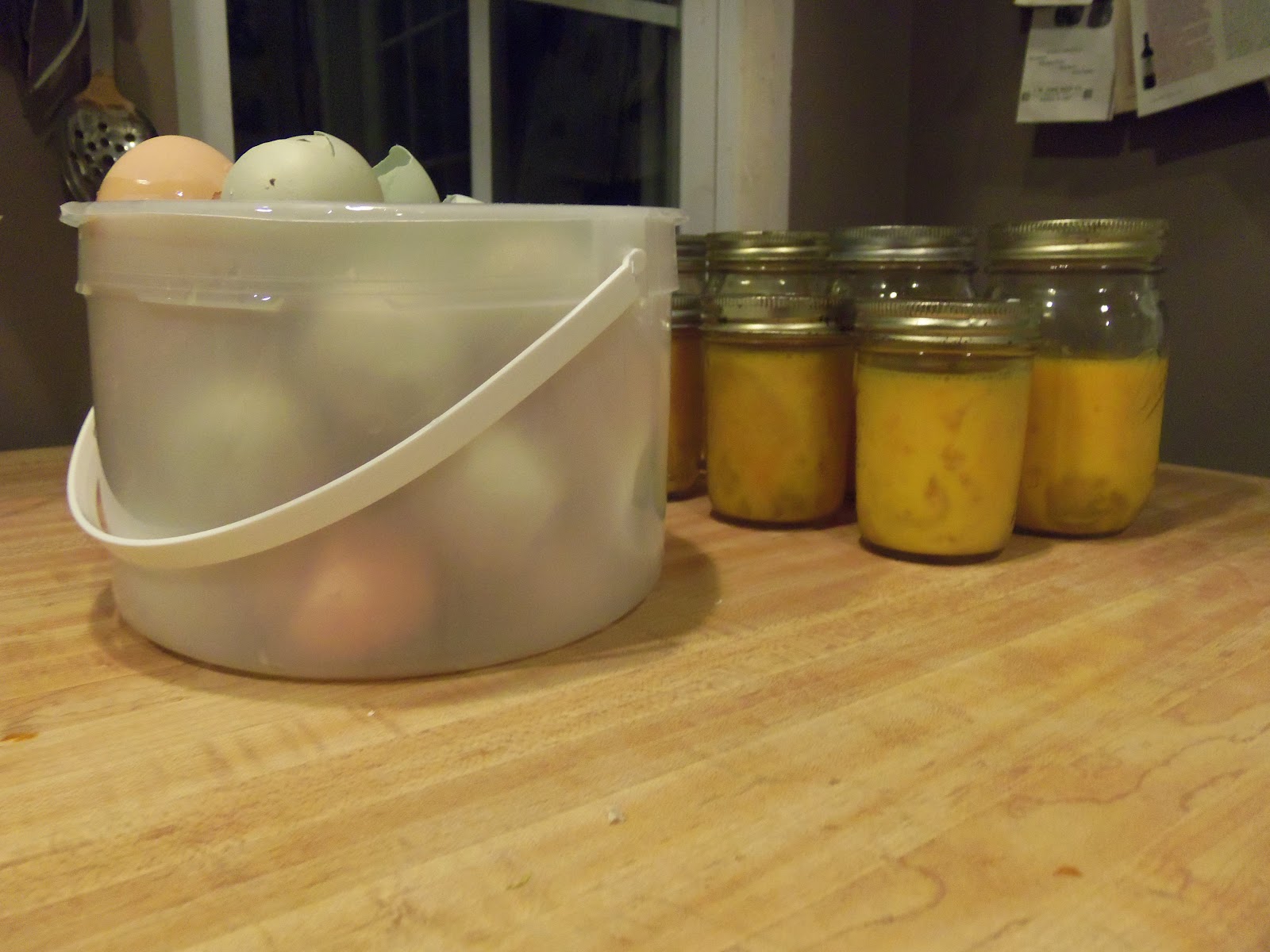
I looked in the fridge and realized it was holding 10 dozen eggs. Granted, we'll be making ice cream soon, and we do enjoy the occasional egg scramble, but 10 DOZEN EGGS! I decided that tonight was the night that I would freeze some for later use. In the winter, despite having five hens, I usually have to run to the store for eggs because my ladies are molting. A goal of mine is to never hardly buy eggs from the store. This should help me on my way.

I did some research and found that freezing eggs is really quite simple. I chose to use Ball jars to freeze four or six eggs per jar. All you need to do is:
1. Crack the desired number of eggs into a bowl.
2. Mix until the yolks and whites are indistinguishalbe from one another.
3. Pour into jars. Be sure there is a 1" or more head space. I tended to go with more head space just to be safe and because I like the 4-6 egg quantity per jar.
4. Label jars with the number of eggs and date.
5. Put in the freezer for up to one year.

In total, I froze 40 eggs tonight. I would have kept going, but I ran out of small jars.

The chickens will be excited to get all of those shells in the morning, too!

Easy Peasy!!! Jars of eggs for the winter. Hallelujah!

Sunday, June 17, 2012

Cocky Rocky, the Rooster

Rocky and Spinderella (pic from last fall)
Rocky, the rooster, is exhibiting his cockiness a little too frequently. The moment one of us opens the coop door for the hens in the morning, Rocky hops out and waits to say hello to his hens. Each lady peeks out and ponders whether or not the joy of the outdoors is worth risking being Rocky's favorite gal of the A.M. Eventually, each of our lovelies decides she'll face the danger, but what a way to start the day...every day.

Lucy-poo has never fully gotten her feathers back from last fall's molting. Unfortunately, I don't see her feathers growing back anytime soon. Rocky's feet grab onto her sides, exactly where her bare skin is already showing. Her neck is also nearly featherless. And I think her skin is getting sun-burned.

Check our her  neck too.

Up close. Poor Lucy!
What to do?  I called our chicken doctor, and she assured me this is all natural. I guess so, but I wonder if this is really too much. Do I need more hens? Should I separate the hens from Rocky for a while? I've hesitated in doing that because it is summertime, and there is not a lot of shade on either parts of our run.And after all, despite Rocky's exploits, I really do love the guy.

Chicken people and non-chicken people, help! Am I being too sensitive, or should I protect my ladies from their overzealous roo? 

Sunday, June 10, 2012

Gardening: Good for the Soul

I'm not going to lie. I had a hard week. Those that know me personally know that I had invested a lot of time and energy in a little Wisconsin election held recently. My side didn't win, and it hit me hard. The first few days afterward, I walked around aimlessly, trying to fight back a sense of hopelessness. Today, I bounced back. I attribute it to the black dirt underneath my fingernails and the farmer's tan I'm currently (proudly) sporting. Today, I realized just how good gardening is for the soul. And as the saying goes, "Gardening is cheaper than therapy and you get tomatoes."

Because of the aforementioned election, I've gotten a bit behind in the garden (and on this blog). Despite our wonderfully early spring, tasks were not getting completed. Nature did not make this any easier: our new soil quickly filled with weeds, transplants got eaten by our resident ground squirrels, and wind gusts knocked out several of our stronger plants. Today, we started many projects anew. 

The silver lining of having some of our planned gardens end up with only withered transplants is that we have FREEDOM to plant whatever we want. I took our large bag of seeds outside and sort of randomly picked what to plant. A lot of my favorites are currently happily germinating. Dry bean plants will soon be crawling up our chicken run netting, and I'll be making kale chips galore.

I recently read a book about the experience of "flow" ~ a state of complete immersion in an experience -- time passes quickly, and despite being tired, you happily persist. I experienced this state today. Pulling weeds, watering, hoeing the soil, planting seeds, pulling, watering, planting, pulling, watering, planting. Finally, twelve garden beds later, I looked up, saw Andy immersed in his own work, and I went in for a glass of iced tea. Content. Free. Peaceful. 


This post is not to over-dramatize this day or experience; rather, I believe quite often harmony comes to us when we simply sit back and do what nature intended. Could another activity bring me so close to the earth? My undergraduate class which involved reading only Thoreau and Emerson is soaring back to me...I think those transcendentalists really were onto something.

Tuesday, May 15, 2012

First Weeks of Beekeeping

Three weeks into beekeeping
We got bees! Finally! After 1.5 years of a  vacant top-bar beehive, perfectly situated among apple, pear, and mulberry trees, our hive is full of active, working, and -we hope- happy honeybees. Fearful that bees would be swarming our yard, making it unsafe for our puppy or chickens to frolic without getting stung, I am happily surprised that my worst-case scenario beekeeping anxieties have been put to rest. Instead, I find our honeybees working earnestly, going to and fro from fruit trees and flowers to their hive and back again. It is memorizing and inspiring. So focused are these bees. So peaceful is it to sit among them and watch.

Our bees arrived three weeks ago, and like any new venture in life, starting to keep bees required that we did some research. The morsels of knowledge that we gained that we'd like to share are all, in our opinions, important and useful for those wishing to possibly take the bee plunge too.

  • First, we decided to get a top-bar beehive. Though there will not be as much honey to extract using this type, it is a model that resembles the natural way a colony of bees would build a hive. In this way, it is said to be a more humane model. 
  • Second, your hive should be placed where it will be in the sun in the morning and early afternoon, but in  the shade in the afternoon and evening. Many people place their hives where there are flowers and trees to pollinate. Be sure your hive is not too close to the road. Bees can get hit by cars too! 
  • Make sure your bees have access to water. We are currently using a Tupperware lid. Place sticks in the water so that the bees have something to land on.
  • Once your bees arrive, check that the queen is still alive. Ours came in a screened box with a candy plug. While the colony adjusts to her scent and accepts her as their queen, they will eat the candy and release her. The hope is that by the time that they eat through the candy, the queen will be accepted and the bees will begin laying eggs and building a comb. 
    • Do not release the queen early. She could die. The other bees may kill her. They should let her out within five days.
  • Many of our bees were dead when we opened the box. Try to order from the most local place possible. Check with local honey producers. They may have swarms to sell.
  • Feed the bees a honey and water mixture twice a week for the first few weeks. You can stop when the bees have established themselves, and there are enough flowers and trees to keep the bees happy and satisfied. 
    • NOTE: it has recently been in the news that the chemicals used in corn production could be the cause for some colonies dying. Some beekeepers use corn syrup instead of honey to feed the bees. Because most corn syrup comes from corn that has been hit with loads of pesticides, this is not a good idea for the health of your buzzing little friends. Thank you, Monsanto!
One week into beekeeping


Check out our video of bees, three weeks in!


Just like our venture into chicken keeping, this adventure has broadened our perspectives and put us one step closer to being in tune with all things good . .  and sweet.  Cliche, yes, but sometimes, lying back in the grass on a sunny day, listening to the slight buzzing of the bees, the coos of the chickens, and the dreams of our dog, I can't help but feel an overwhelming sense of thankfulness.